
PROJECT REPORT
- Continuation of Odisha Millet Mission In Tribe Area
- Implemented by: Ishaneswar Yubak Sangha (IYS)
- Block: Sanakhemundi, District: Ganjam, Odisha
ISHANESWAR YUBAK SANGHA (IYS) is a community-based not-for-profit voluntary organization registered under the Societies Registration Act of 1860 in the district of Khordha, Bhubaneswar, Odisha. It has been over a period of over actively twenty years since its inception in 1982, IYS has consistently sustained its present and community action to transform lives. Started as a local community group of philanthropists and traditional social workers, the organization has evolved as a professional programme with planning and implementation organization. It has brought diversity toits community engagement programme planning to include children, youth, women and senior citizens, mostly vulnerable, excluded, marginalized and deprived due to their lack of ability and self-potential to raise their voices. IYS played a catalytic role to anchor their voice through enhancement of education, youth empowerment, community health action, and mobilization of women self-help groups development of SC, ST and minority community of people have been added to the core mandate of the organization still evolving and includes emerging new areas of development imperatives. Climate action, biodiversity, water, sanitation and environmental protection are a few, but significant and dynamic community issues addressed by the organization through partnering with government department ministries, both at the state and national level and collaboration with CSR corporate business houses and grant-making institutions
1. Executive Summary
Ishaneswar Yubak Sangha (IYS), registered at AT- Nabinabag, PO/PS/Dist. Khordha, Pin-752055, Odisha, is an official Facilitating Agency (FA) under the Government of Odisha's Odisha Millet Mission. (On Going) IYS has been successfully implementing the millet promotion programme in the Sanakhemundi block of Ganjam district.
The project focuses on reviving ragi (finger millet) and other millets through improved production, capacity building, organic practices, awareness campaigns, and consumption promotion. Key interventions include SMI Training, CC, LC, LT, RATHA, CRP Training, Bio-Input promotion, and Tiffin Centre activities.
These activities have directly benefited tribal and small farmers by increasing yield, reducing input costs, creating awareness, and linking millets to nutrition and income. The project aligns with the national Odisha Millet Mission goals of climate resilience, nutrition security, and women's empowerment.
To sustain and scale these proven interventions in the next phase for 1 year, IYS requires ₹15,00,000 as a continuation grant. This will cover staff salaries, training, bio-inputs, Ratha campaigns, tiffin centre operations, and monitoring. With this support, the project will continue transforming Sanakhemundi into a model millet hub.
2. Background of the Organisation and Project
Ishaneswar Yubak Sangha (IYS) is a strong NGO working since many years in Khordha and Ganjam districts on agriculture, women empowerment, and rural development. Its field office is at Bhaliajhola, Sanakhemundi block, Ganjam (Pin761013).
The organisation was selected as Facilitating Agency by the Directorate of Agriculture & Farmers' Empowerment, Government of Odisha, for the Special Programme for Promotion of Millets (Odisha Millet Mission).
Odisha Millet Mission aims to revive millets in farms and on plates. Millets like ragi require less water, tolerate drought, and are highly nutritious – ideal for rainfed areas of Ganjam. The mission promotes System of Millet Intensification (SMI), organic farming, farmer training, awareness, and market linkages. IYS is implementing all components effectively through community participation.
3. Detailed Project Activities and Analysis
The programme includes the following key activities. Each has been analysed for its technical merit, impact on farmers, and contribution to Odisha Millet Mission goals:
a) SMI Training (System of Millet Intensification) SMI is the core improved agronomic practice promoted under the mission. It involves 12-15-day-old seedlings, proper spacing (25cm x 25cm), line transplanting, and organic nutrient management.
Analysis: Traditional broadcasting gives a low yield (8-10 quintal/ha). SMI increases yield by 30-50% (up to 15-20 quintal/ha), reduces seed use by 80%, and saves water. In Sanakhemundi's undulating terrain, this has helped farmers face climate change better. Regular training has built farmers' skills.
b) CC & LC (Cluster Coordination & Lead Cluster Activities). These involve forming farmer clusters, lead farmers, and coordination for input supply, demonstration plots, and group marketing.
Analysis: Cluster approach ensures lastmile delivery. CC helps in regular monitoring and LC creates model plots for peer learning. This has strengthened community ownership and reduced drudgery.
c) LT (Line Transplanting) & Related Practices LT is part of SMI – seedlings are transplanted in straight lines for better aeration, weeding, and nutrient uptake.
Analysis: Combined with SMI, LT increases plant population, reduces weed competition, and boosts productivity. Farmers report easier intercultural operations and higher ragi grain quality.
d) RATHA (Millet Awareness Ratha / Prachara Ratha) Mobile Millet Ratha campaign – a decorated vehicle moves through villages with demos, songs, recipes, and seed distribution. Analysis: Started in 2022, this innovative IEC (InformationEducation-Communication) tool has reached hundreds of households. It creates mass awareness about millet nutrition and breaks the “poor man's food" myth. Highly effective in tribal pockets of Sanakhemundi.
e) CRP Training (Community Resource Person Training) Progressive farmers and youth are trained as CRPs (2-day residential/non-residential modules) on SMI, organic practices, and data collection. Each CRP handholds 20-30 farmers. Analysis: This farmer-to-farmer extension model is cost-effective and sustainable. CRPs act as local experts, ensuring continuous technical support even after project staff leave. Over 2+ years, this has created a strong local cadre.
f) Bio-Input Promotion (Organic Farming) Training and supply of bio-inputs (vermi-compost, bio-pesticides, jeevamrut, etc.) to replace chemical fertilisers. Analysis: Promotes soil health, reduces the cost of cultivation by 25-30%, and produces chemical-free ragi for better market price. Aligns perfectly with the organic millet hub vision of Odisha Millet Mission.
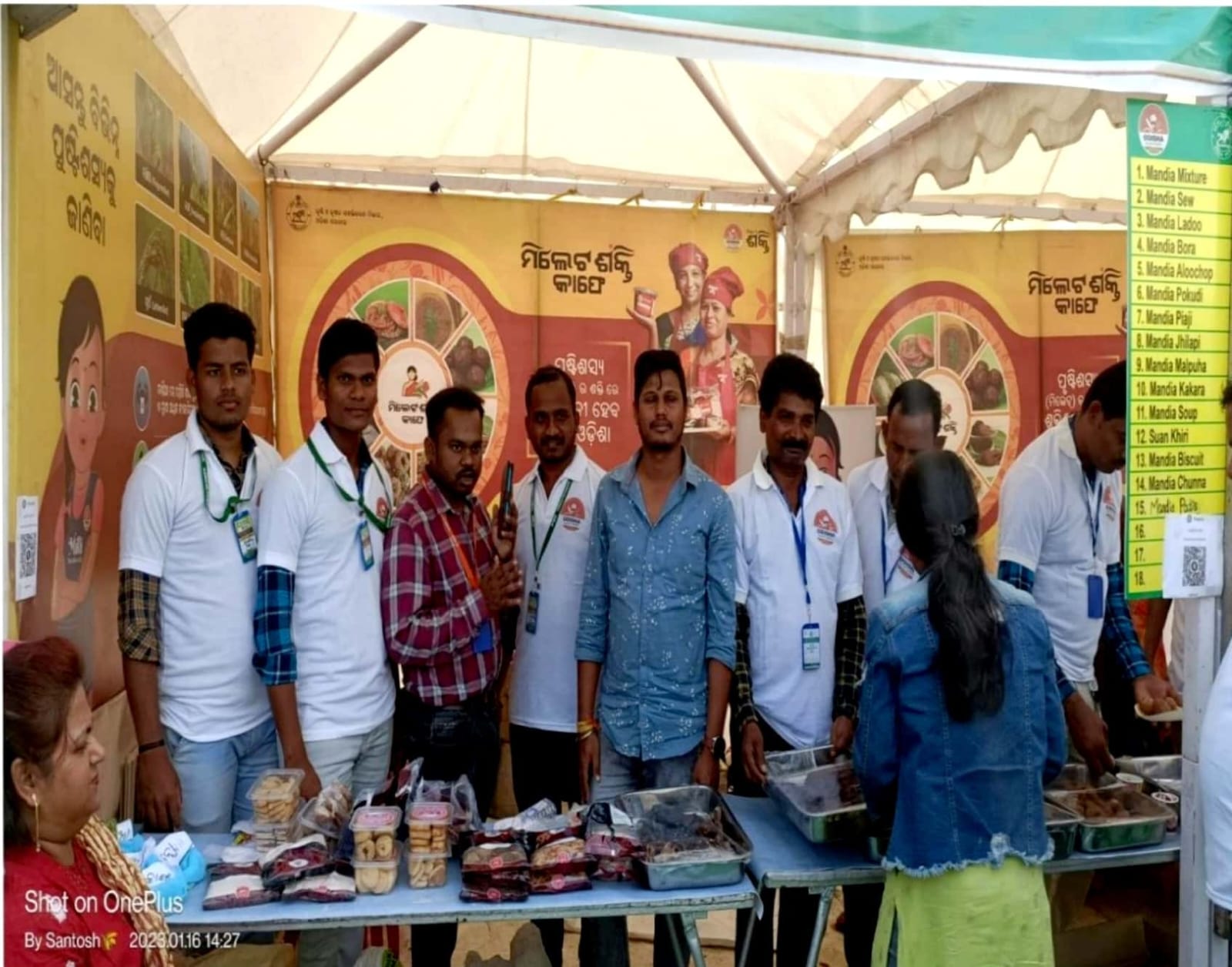
g) Tiffin Centre Programme SHG women run community/millet tiffin centres or outlets serving ragi-based snacks, meals, and recipes. Analysis: Directly addresses the consumption gap. Children, youth, and families now eat millets regularly. This creates local demand, additional income for SHGs, and nutritional security. Links perfectly with the "millets on plates” objective.
Overall Analysis: All activities are interlinked - production (SMI, LT, Bio-input) + capacity (CRP, CC/LC) + awareness (RATHA) + consumption (Tiffin Centre). This holistic approach has revived ragi in Sanakhemundi, improved farmer income, empowered women SHGs, and contributed to climate-resilient agriculture.
4. Project Staff Structure
The project is professionally managed by the following dedicated team
Core Staff (IYS):
- Block Coordinator: Mr Siba Pradhan (Mob: 9178787440, Email: pradhansiba2019@gmail.com) - Overall project management, training, and monitoring.
- Additional Block Coordinator: Mr Santosh Kumar Rauta (Mob: 7787994648) - Field coordination and farmer mobilisation.
- Project Accountant: Mr Sameer Kumar Patro (Mob: 9668136655) – Financial management and reporting
Chief Functionary of IYS: Mrs Reena Ray (Mob: 9938109511, Email: iyskhurda@gmail.com) provides strategic guidance.
The team is small, dedicated, and local, ensuring high accountability and low overhead.
5. Impact, Sustainability & Way Forward
The project has created visible change: higher ragi yields, organic practices adopted, increased millet consumption, and empowered women through SHGs and tiffin centres. The Ratha and CRP models have ensured wide reach and ownership.
Sustainability: CRPs and SHGs will continue even after external funding reduces. Linkages with government procurement (MSP for ragi) and local markets are being strengthened.
Challenges: Limited funds for scaling trainings, bio-input supply, and Ratha campaigns. Climate variability still affects small farmers.
Way Forward: Continue all activities for 1 more year and scale to nearby GPs. Focus on value addition, women entrepreneurship, and digital monitoring.